
About Mathamagic
MathaMagic offers parents, teachers and students a developmental and individualised approach to building an understanding of Number through evidence based practices that create an integrated and functional awareness of numbers and early arithmetic.
“Mastery with fluency ‘is built up of facts as a house is of stones, but a collection of facts is no more than a pile of stones is a house’’” (Poincare,1905, as cited in Baroody et al., 2009, p.70).
Why number and early arithmetic are a crucial element of early years education
An ongoing concern in education is the lack of students pursuing mathematics subjects in the later years of high school and tertiary education. Numeracy skills are widely regarded as one of the key requirements for success in school and crucial knowledge for future careers. As society becomes more technologically advanced, the number of proletarian professions and positions are reducing in number, whilst the number of professions requiring analytical thinking, creative problem solving and adaptive thinking are on the rise, demanding that individuals have knowledge, skills and expertise to contribute. However, it has been found that as many as 20% of Australian adults lack basic numeracy skills to simply cope with the demands of 21st century living.
Researchers have found that signs of insufficient numeracy skills can be traced back to the early years of schooling (Jordan et al., 2009, Aunola et al., 2004) and that early years’ performance is an established indicator of future growth. Students experiencing difficulties in the early years continue to experience difficulties as they attempt more advanced maths due to the lack of foundational knowledge to build connections. In fact, it has been established that by the age of as young as eight, a student has an acute awareness of their academic capability (Sullivan, 2011; Adelson & McCoach, 2011) based on past performance, that in turn influences their self perception as a learner (Bandura, 1986). Therefore students who have experienced difficulties in early years numeracy are more likely to have a negative attitude towards mathematics, start to avoid maths related tasks and develop maths anxiety.

Research Based Overview
MathaMagic offers students opportunities to learn, apply, and practise different strategies over time to build lasting understanding.
Research suggests: targeting maths concepts through the use of appropriate teaching strategies leads to more accuracy and proficiency (Siegler & Jenkins, 1989). At first, a student will rely on immature strategies that are meaningful to them such as counting by ones, but will progress to more mature strategies through a focus on numerical thinking and exposure to more sophisticated ways of calculation. Mastery grows out of opportunities for students to accurately use more efficient strategies and develop a well structured, connected web of number knowledge (Gersten & Chard,1999).
MathaMagic provides opportunities for students to explore maths concepts at their stage of development and build connections.
Research suggests: maths ability develops in a hierarchical manner (Aunola et al., 2004) with students progressing through three phrases: 1) Counting Strategies 2) Reasoning Strategies 3) Mastery (Baroody et al., 2009). “Knowledge of children’s developmental progressions and the use of appropriate teaching strategies to help them move along those progressions are important in developing children’s maths concepts” (See, 2019, p.24).
MathaMagic is designed to highlight the important role parents play in fostering children’s mathematical development and to support meaningful parental engagement in their child’s numeracy education.
Research suggests: parental engagement is closely linked with mathematics achievement (Cai, 2003). Parental engagement contributes to higher academic outcomes, emotional development and positive behaviour (Clarke et al., 2006). “Schools that undertake effective parental engagement are … up to ten times more likely to improve numeracy” (CEM, 2013, p.5).
Program Evaluation
To gauge the effect of the program since its introduction in 2018, a research project entitled “The Impact of a Number and Early Arithmetic Program, Encouraging Active Parental Engagement, on Students’ Mathematics Knowledge” (Crane, 2020) evaluated the impact of the MathaMagic program on student outcomes at School of MathaMagic. The evaluation compared the results of year levels exposed to the program (2018, 2019) and the results of students in the early years prior to its implementation (2017).
The nuts and bolts of the evaluation
Student outcomes of 178 participants from Grade 1 to 3 were included in the analysis. Foundation students, although part of the program, were omitted as there was no reliable data to analyse. Two assessments used at the School of MathaMagic as part of the current practices, Progressive Achievement Test in Mathematics 4th edition (PATM) and the National Assessment Program – Literacy and Numeracy (NAPLAN) provided overall mathematical achievement data that were used to evaluate the impact of the MathaMagic program and identify variations in results. Although they both measure overall performance, each assessment tool has been proven to be a valid and reliable measure of student outcomes and both are widely used across Australia. PATM, developed by experts, enables the accurate comparison of student mathematical achievement with over six hundred thousand students (a norming group). The test is routinely administered at the school in May and November each year. NAPLAN, used to measure academic progress against national standards, compares the achievement of School of MathaMagic with all schools from Victoria and is normally administered in May.
The evaluation analysed data from students of the same year level but at different points in time; the comparison between the different groups of students aiming to identify the variations in the outcomes of that year level. The advantage of comparing successive years’ data is that it is likely that the groups of students were similar to each other and experienced the same schooling conditions. However, the evaluation had to consider the effect of the MathaMagic against other factors that could have been present purely from the random differences in the groups. To estimate how much of the variation was due to the systematic implementation of MathaMagic and how much variation was due to unsystematic factors such as characteristics of the group, the data was analysed using the most widely used statistical package in educational research, IBM SPSS v.27 for Macintosh (SPSS, 2020). The package calculates whether variations in outcomes could have happened by chance by using the benchmark of p<0.05, meaning that if the value is found to be less than 0.05 (or 5%) it is highly unlikely the differences occurred purely from chance. The package can also establish if the effect has any practical usefulness and is educationally significant by calculating how large the strength of association was using effect size (Cohen’s d) which indicates the magnitude of the effect.
The nitty gritty of the results
PATMaths
The results of the statistical analysis of PATM student outcomes confirmed a statistical significance between the group of students in Grade 1 (F(2,107)=15.142, p=0.00) and 2 (F(2,100=4.122, p=0.019) who were at School of MathaMagic prior to program implementation, as compared to the students in 2018 and 2019 participating in the program. Students in 2018 and 2019 were more likely to achieve a score higher than those in 2017 with the average PATM score of the 2018 and 2019 students noticeably higher than 2017 and the spread of scores closer to the average post the introduction of the program (Table 1). Not only did the analysis of these outcomes establish that the difference was highly unlikely to have taken place purely by chance, the differences in outcomes were found to have a medium to large effect on student results (d=0.52 to 1.14). Therefore changes in the PATM scores in Grade 1 and 2 over the time period were found to be both statistically and educationally significant.
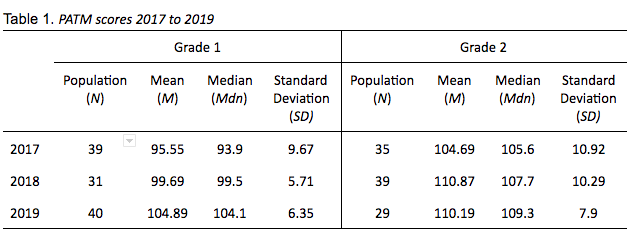

The percentage of Grade 1 students who achieved the average score of grade 1’s nationally (as compared to the norm group) increased from 80% in 2017 to 100% in subsequent years (Figure 1). However, the percentage of students who achieved the average score of the norm group of grade 2’s, whilst noticeably positive in May, gained in November of 2018 and dipped in November of 2019. The anomaly of the percentage of Grade 2 students in 2019 achieving the PATM average level achievement as compared to other cohorts and time periods indicates that further analysis is required.
NAPLAN
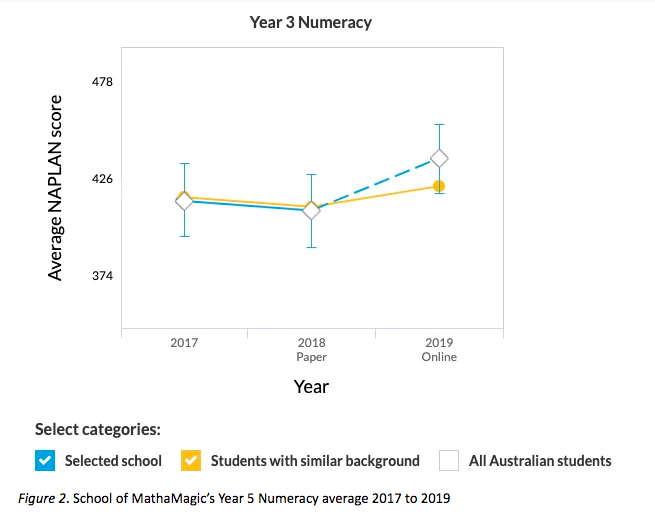
Students in Grade 3 in 2019 were part of the MathaMagic program for one year prior to NAPLAN testing, whilst in 2017 and 2018 students had graduated from the early years prior to MathaMagic’s implementation. Comparison of the School of MathaMagic NAPLAN outcomes revealed a noticeable gain in average results of students at the school in 2019 (M=441) as compared to state (M=419) and schools of a similar demographic as shown in Figure 2.
Comparison with a matched cohort of students whose backgrounds were similar establishes that the increase is significant as it would be expected the students from similar backgrounds achieve similar results. This comparison is also significant as the increase in results could have been attributed to a change in the NAPLAN administration from pen and paper to online, but this should be mirrored by matched, state and national cohorts’ results, which was not the case.
The ‘so what’ now…..
The aim of the evaluation was to establish whether MathaMagic; a developmental number program in the early years; has led to an improvement in student outcomes. Results, generalised from the analysis of the norm referenced PATM and national benchmark NAPLAN assessments, have shown improved students’ mathematics achievements overall, and support the belief that developing number sense and numerical reasoning in the early years, through take home resources, has a positive impact on student outcomes, although further evaluations have been recommended. With this in mind, we encourage parents to continue to work in partnership with School of MathaMagic to develop number and early arithmetic knowledge through practices grounded in research as suggested on the MathaMagic cards. Actively encouraging more sophisticated strategies from those a child currently possesses by engaging in conversations about reasoning and strategy choice is of great value, if for no other reason, than that it enables beliefs about mathematics to be fostered (Baroody et al., 2009).
“There is much to gain, and little to lose, by engaging young children in mathematical experiences,”
(Clements & Sarama, 2011, p.968).